















You are using an outdated browser. Most of this website should still work, but after upgrading your browser it will look and perform better.
- Home
- Undergraduate Courses
- BA (Hons) Modelmaking
- Course details
BA (Hons) Modelmaking
- Duration: 3 or 4 years full-time
- Placement year: Optional 1 year
- Course code: W291 (UCAS)
- Institution code: A66 (UCAS)
BA (Hons) Modelmaking
BA (Hons) Modelmaking is your stepping stone to an exciting career in making.
With hands-on experience and access to the latest technology and traditional resources, you'll learn to make things using an extensive array of materials, tools, and techniques. You'll develop the making skills needed for rewarding careers in film, architecture, exhibition, and design. You'll develop as an independent thinker, capable of solving problems and taking imaginative leaps in creative design and making.
You'll work on live collaborative projects with students from other courses and with industry professionals. Using our strong links with the creative industries, you'll have opportunities to undertake work experience with leading companies in the UK and abroad.
This course has been the first step in the journeys of many successful graduates, leaders, and innovators who continue to excel in a broad spectrum of the creative industries and beyond.
Three reasons to study BA (Hons) Modelmaking at AUB:
- Our course offers a multidisciplinary approach to making for the creative industries and beyond, equipping you with a diverse skill set and deep industry knowledge. This ensures that you can pursue careers aligned with your personal interests and professional aspirations.
- Our course team fosters a unique, collaborative studio culture where you'll learn in a supportive and creative environment. Working alongside like-minded peers and experienced tutors, you'll develop confidence in your skills, receive tailored guidance, and thrive within a community that values innovation, craftsmanship, and professional growth.
- Our course provides hands-on experience with industry-standard equipment, ensuring that you're fully prepared for professional practice. From advanced digital fabrication tools to specialist workshop machinery, you'll gain expert training that bridges the gap between education and real-world modelmaking careers.
Placement year
All undergraduate courses at AUB offer an optional placement year, to be taken between your second and third years of study.
If you’re unsure about this optional placement, you don’t need to decide now. Once you’re here and studying with us, the course team will discuss the placement options with you, so when the time comes, you can make a decision that’s right for you.
Exchange and international summer programmes
Students on BA (Hons) Modelmaking have the chance to broaden their horizons through exciting exchange and international summer programmes. These opportunities allow you to study abroad at one of our brilliant partner institutions, experience different cultures, and enhance your academic journey.
Level 4 (first year)
You're introduced at Level 4 to all the core skills of a professional modelmaker: making processes and techniques, design thinking, and the essential function of the model as a form of communication.
Previous assumptions about skills, methods, thought processes, and representation are challenged, reframed, and developed to build the necessary foundations for professional practice.
During Levels 4 and 5, a lecture programme, reinforced by studio discussion and debate, will introduce you to theoretical concepts and a wide range of issues including audience, communication, sustainability, and ethics, which will underpin your development as a modelmaker.
Level 5 (second year)
In the second year, you'll continue to develop your understanding of modelmaking as a form of communication. Interpretation and representation are studied and practised in a variety of different professional contexts.
Attention is turned outwards to clients, to industry and to society. Engagement and interaction with industry, audiences and consumers are integrated into the curriculum, as is research, reflection and the use of writing to develop understanding.
You're encouraged to develop interests and lines of enquiry that'll inform your choice of creative and career directions in the third year.
The course seeks to facilitate your self-discovery and to build confidence in pursuing independent paths in skill development, reflection and enquiry, and in choosing career directions.
Level 6 (third year)
In the final year, the direction of the course and of your decision-making is firmly towards the outside world as characterised by clients, the industry and audiences. As part of this, however, there's a continuous process in which you're expected, through research and work experience, to 'benchmark' standards of performance, and to define, manage and meet your own personal standards of excellence.
Expectations are set that you'll demonstrate high levels of ambition as well as achievement and demonstrate the flexibility and resourcefulness appropriate to a professional in achieving those goals.
The course supports you to engage staff in dialogue over decision-making, from an independent position. You're encouraged to identify yourselves as members of your chosen professional field, to make connections through personal contact and research and to 'prepare for success' by seeing yourselves as professionals already in practice.
Teaching, learning and assessment
The course combines independent learning and structured taught sessions.
Each unit is assessed separately, and the assessment forms part of the unit. Assessment both provides a measure of your achievement, and also gives you regular feedback on how your learning is developing.
Teaching includes guided studio sessions, inductions, demonstrations, specialist workshops, individual and group tutorials, seminars, group critiques, lectures, and study visits. These are delivered by a course team of industry-experienced professionals. The teaching is further supplemented by the invaluable input of visiting professionals, supplying the course with a wide range of current skills and industry knowledge. Work experience and company visits also provide highly valuable learning opportunities.
Universities interviewing for creative courses will expect to be presented with a portfolio to help them understand your ability and range of work. Your portfolio could be your golden ticket into receiving an offer so making sure it’s presentable, well-organised and accessible is essential.
Independent learning includes studio practice, research, analysis and critical reflection. Teaching by the course team is directed at supporting you in managing your learning. You're encouraged to develop strategies for independent learning and time management on each unit of study and this responsibility progresses as you move through the levels of the course where the use of a statement of intent becomes an integral part of the process.
Contact hours include all scheduled teaching sessions, but also supervised time in the workshop or studio. In line with national guidance, we include in our calculation of contact hours all the time which is scheduled in the studio for independent study which is also supported by staff (either academic staff, or technicians).
The information provided below gives the proportion of your study time which constitutes contact hours. Where there are optional routes through the course, we have used the figures for the most popular option.
For every unit of your course, we'll inform you of what you're expected to learn; what you have to submit; how your work will be assessed; and the deadline for presenting your work for assessment. This is made available through Unit Information, which is on your course blog.
You'll receive a final mark for each unit in the form of a percentage, which will be recorded on your formal record of achievement (transcript). Each component of assessment is graded using a notched marking scale, whereby only certain marks are used within each grade. The only marks available within any ten-point band are *2, *5 and *8 (e.g. 62, 65, 68). These marks correspond to a low, mid, and high level of achievement within each grade band.
All learning outcomes must be passed to successfully complete the unit.
On successful completion of your Honours degree course, you'll be awarded a degree classification based on your unit marks. The final classification is determined using all unit marks at Levels 5 and 6 using two different algorithms, which are detailed in the HE Student Regulations. If the two algorithms produce different results, you'll be awarded the higher class of degree.
If you have joined Level 6 through either the Recognition of Prior Learning (RPL) route or having completed a Foundation Degree (FdA), the final classification is determined using only your unit marks at Level 6.
For further information on assessment, progression, awards and classifications, please visit https://viewpoint.aub.ac.uk
Course costs
The fee you pay AUB provides the necessary equipment and training for you to complete your course.
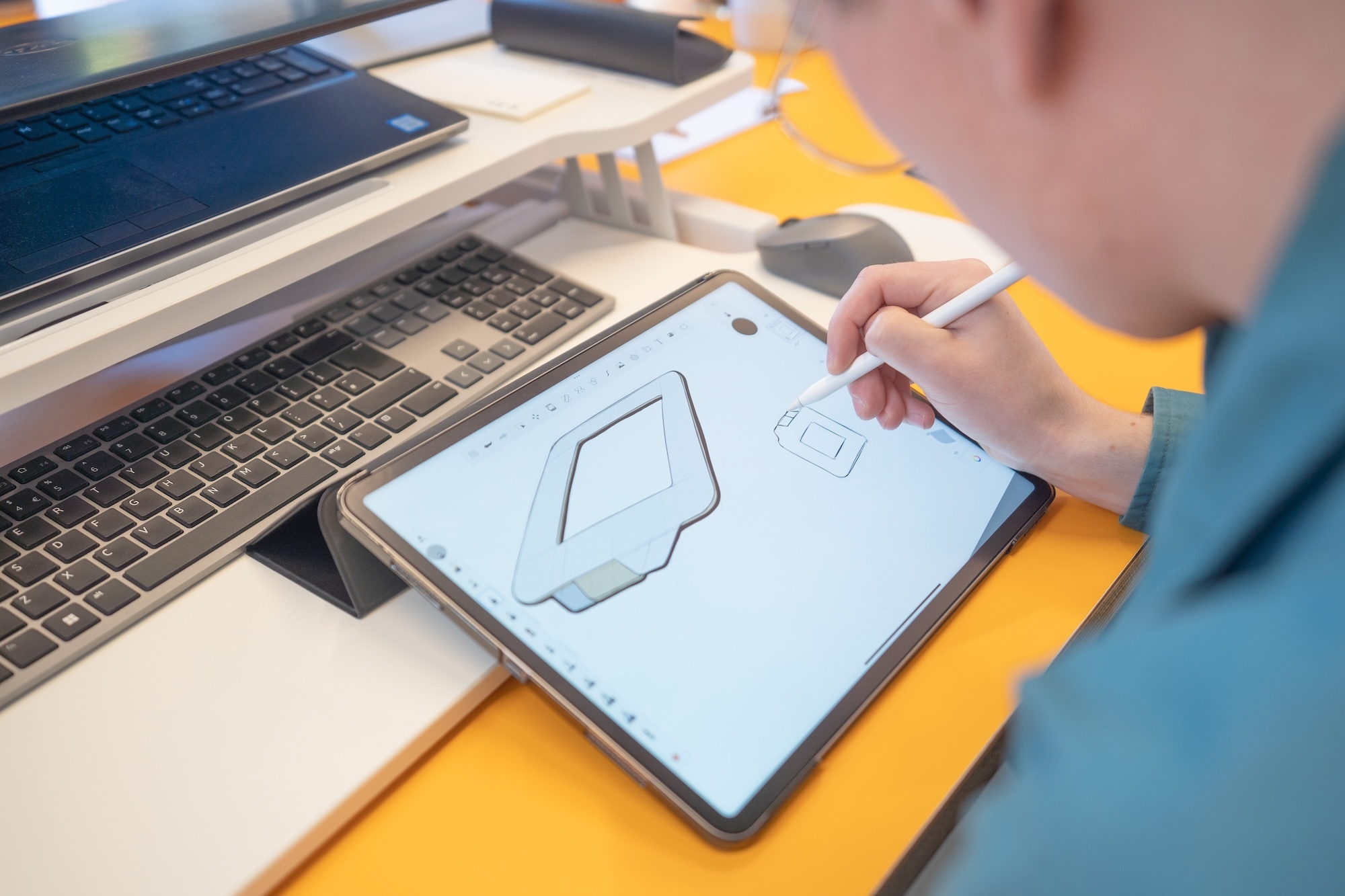
In most cases, you don't need to buy any specific items of kit before you start the course. You may also choose to buy some items of personal equipment such as a laptop or tablet computer, but this isn't required – desktop and laptop computers are available for you to use in common study areas, including a loan system in the Library.
It isn't possible to be precise about the likely additional costs that you may incur, because this depends on the choices you make and the projects you undertake. The University provides some basic materials, and you'll be encouraged to work sustainably and to reuse materials where possible, but you should still expect to make some financial investment.
For more information, including costs relating to certain courses, visit our Course Costs page.