










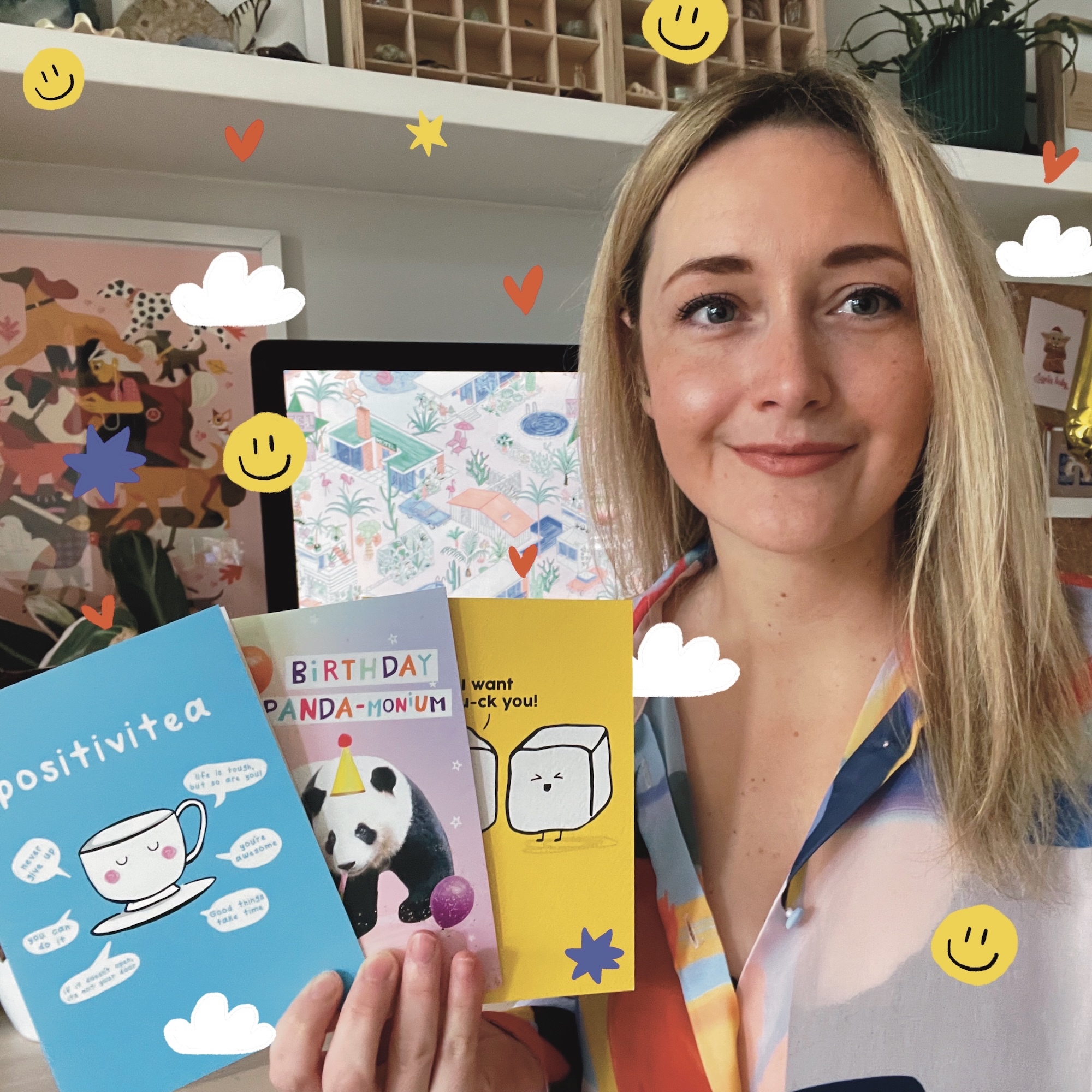
We took the opportunity to scribble down some questions for the inspirational Creative Director at Scribbler, Aisling Crosland. As well as holding a very impressive role at the OG fun card company, Aisling is an AUB alumna, having graduated with both BA (Hons) Illustration and MA Illustration!
AUB’s BA (Hons) Illustration course has a close relationship with Scribbler as it delivers a live brief to the students each year with the winning designs being sold in Scribbler shops across the country.
Here, we find out a bit more about Aisling’s journey from AUB to Scribbler:
What was your AUB experience like? How did you decide to come here? Did you always know you were going to do the MA as well?
It feels like a lifetime ago that I first set foot in Bournemouth. Back then, I was all set on applying for graphic design courses elsewhere – but something just didn’t click. Then fate (and my friend’s car) intervened. She was heading to AUB to check out the fashion course, so I hitched a ride for the day out.
One conversation led to another, and before I knew it, I was chatting about the Foundation course and thinking, “Why not try a bit of everything before I commit?” It just felt right. Also, it was sunny, there was a beach… and honestly, that pretty much sealed the deal. I had no idea at that point that I’d end up on the Illustration course, let alone doing an MA.
Was it clear to you during your studies what you wanted to do once you’d graduated with your MA?
The print rooms – and the amazing Preeti – completely won me over. That’s where I first fell in love with printmaking, which, in a wonderfully roundabout way, led me to what I do now.
These days, it’s all on a much bigger, industrial, global scale – but that same excitement for the craft behind the finished print started right there. Visiting factories and watching the machines in action is still one of my favourite parts of the job – and I'll always have a soft spot for a Heidelburg platen press.
Could you talk us through your professional journey from leaving AUB to Scribbler?
When I left AUB, I had absolutely no idea what I wanted to do for a living — which, as it turns out, is a very common side effect of graduating. Finding a job was tougher than I expected (turns out everyone else had the same idea), so I did what any sensible, mildly panicked creative would do: I went travelling. Somewhere between airports and sketchbooks, I dabbled in illustrating children’s books for various authors, before landing a temporary role at UK Greetings — the UK’s biggest greeting card publisher.
What started as a three-month contract quickly turned into something more. Within weeks, I’d fallen head-over-heels for the industry. It was like something just clicked – that elusive “passion” everyone talks about finally made sense. In those early days, I was on a mission to learn everything I could. For someone who’s naturally non-competitive, I suddenly became very determined – attending every training session, pestering experienced designers for tips, building mood boards, and obsessing over trends and colour palettes. I also discovered that in retail, it’s not just about making something you like – it’s about creating designs people will actually buy… and doing it fast.
I absolutely loved my time at UKG, but the studio was based in Corby, and my partner (who I happened to meet at AUB) and I were keen to make the move to London. So, I started hunting for a job in the same industry, just somewhere with a bit more city buzz. I already knew and adored Scribbler – mostly thanks to spending far too much time (and money) in their Bournemouth shop as a student – so when I spotted what I thought was a current job posting for a designer, I jumped on it. I enthusiastically sent over my portfolio… minus one small detail: I forgot to attach it.
By some miracle, the senior designer emailed me back to let me know the ad was actually out of date. But, as luck would have it, a new position had just opened up, and they invited me in for an interview. That interview turned out to be with John Procter, the owner and founder of Scribbler, and I remember it vividly. We spent a solid hour debating (okay... bickering) about the greeting card industry. I left convinced I’d completely blown my chance at my dream job. But, as it turns out, John must’ve appreciated the passion, and the fact I wasn’t afraid to stand my ground. He called me before I’d even made it off the train home to ask when I could start. The rest, as they say, is history.
We know you’ve been at Scribbler for a long time now – over eight years. Can you tell us about when you started, what you were doing and how you found it compared to previous experiences?
When I started at Scribbler, we were a relatively small team of only three designers. I’d spent my prior years at UKG making greetings cards, but at Scribbler the scope was much bigger in terms of design. We were creating cards, packaging, stationery, gifting, point-of-sale and well as web assets like banners, social content and email – so there was a lot to learn quickly.
Cards were, and are, still what I love, but it forced me to be a better designer having to throw myself into projects that were way outside my comfort zone.
We’d also love to know how you progressed from Designer up to Creative Director!
I had to really push for it – and I mean a lot! As I mentioned before, I started out as a midweight designer, and my first step up to senior came quite naturally when someone left and I proved I could handle the extra responsibility.
But the climb after that wasn’t quite so straightforward. At the time, Scribbler was a smaller, fast-growing company, and roles like Head of Design or Creative Director didn’t even exist yet. So, I had to make the case – not just for why I was the right person, but for why the company needed those roles in the first place.
When I joined, there were just three of us in the design team. Now, we’ve grown into a full creative department with designers, copywriters, content creators, and marketing managers. A bigger team needs a proper structure, and that evolution helped shape my own career path too.
I think the biggest factors in getting to where I am now were a mix of passion, persistence, and a lot of curiosity. I threw myself into everything – learning as much as I could about the industry and volunteering for every project that came along – sometimes probably more than I should have! But I also wasn’t afraid to be open about where I wanted to go. I remember telling John that I wanted to be a director before I turned 35 – and I meant it!
Over the years, I’ve had tempting job offers from elsewhere, but I’ve stayed because Scribbler have always listened to me, supported my goals, and given me the tools to get where I wanted to be. It’s been hard work, yes, but also incredibly rewarding to see both my role and the company grow side by side.
What’s involved in being a Creative Director? Do you still get to design or are you more directing and supervising the direction of the brand’s designs?
Stepping up into a director role is definitely a big leap. My job isn’t just about managing the creative studio and overseeing the work we produce anymore (though that’s still a huge part of it) – it’s now also about shaping the overall creative strategy for the whole company. That includes everything from brand direction and wholesale partnerships to innovation and trend forecasting – basically making sure we stay one step ahead of the market and keep offering our customers and clients something fresh and unique.
Of course, the trade-off is that I don’t get to design quite as much these days – but I’m a firm believer in the old saying: “If you don’t use it, you lose it.” So, I still jump in whenever I can.
Plus, I’m constantly learning from the new designers who join the team – their fresh perspectives and approaches keep me inspired (and on my toes!)
How long has Scribbler been giving Live Briefs to AUB Illustration students? How involved are you in the process? Do you get to choose the winners?
Scribbler has been doing live briefs with the illustration course at AUB since 2021. It actually started with John Procter paying a visit to the Vice-Chancellor. After being shown around and seeing all the talent John called me to say we should set something up, and of course after being a student there myself I thought the idea was fab.
I’m pretty hands-on in the process, from creating the brief all the way down to selecting the winners. I've also been honoured to be asked to give a few lectures around the briefs on my industry in general to students across all three years and the MA course.
I tend to select the final winners myself, however, who makes the shortlist and final is down to a panel of judges across our creative and buying teams. Everyone gets X amount of votes as we narrow submissions down. For the final three winners it is usually a combination of whoever has the most votes paired which designs which I think will sell the best in our stores.
Have any card designs been too risky to be included or considered?
Not at all, we encourage students to have as much fun with the ranges as possible. It’s one of the rare briefs where you can really say whatever you want. Two of the finalists for 2025 had the C word in their designs – that’s not the reason they were finalists, but more a combination of strong design paired with humour that we knew would work for our customers.
And – a very hard question – do you have any GOAT designs?
I’ve been designing for so long now that it’s pretty hard to pinpoint one design that’s been stronger than the rest. There are some designs that are years old and still selling strong, and others that I look back on and cringe that I made them. I keep copies of lots of the cards I've made, along with cards other designs have created that I love! As you can imagine, my office is filled with lots of colourful crates overflowing with cards.
If you were starting out again in the world of Illustration, what advice would you give yourself?
You often hear people giving designers starting out advice like “Stay true to your style” – which, to be fair, is great advice… sometimes.
But my slightly more controversial advice? Learn to adapt your style as much as possible! Having your own distinct style is brilliant – it’s what makes your work recognisable, especially if you’re aiming for commissions or selling your own art. But in industries like retail, flexibility is everything. You’re designing for a whole range of customers, constantly keeping up with visual trends and reinventing your approach to stay fresh. The more adaptable you are, the more employable you become – and the less likely you are to get stuck in a creative rut.