









































An Arts University Bournemouth (AUB) postgraduate researcher has won an award at a prestigious international conference for his innovative work on AI-assisted, culturally adaptive design education.
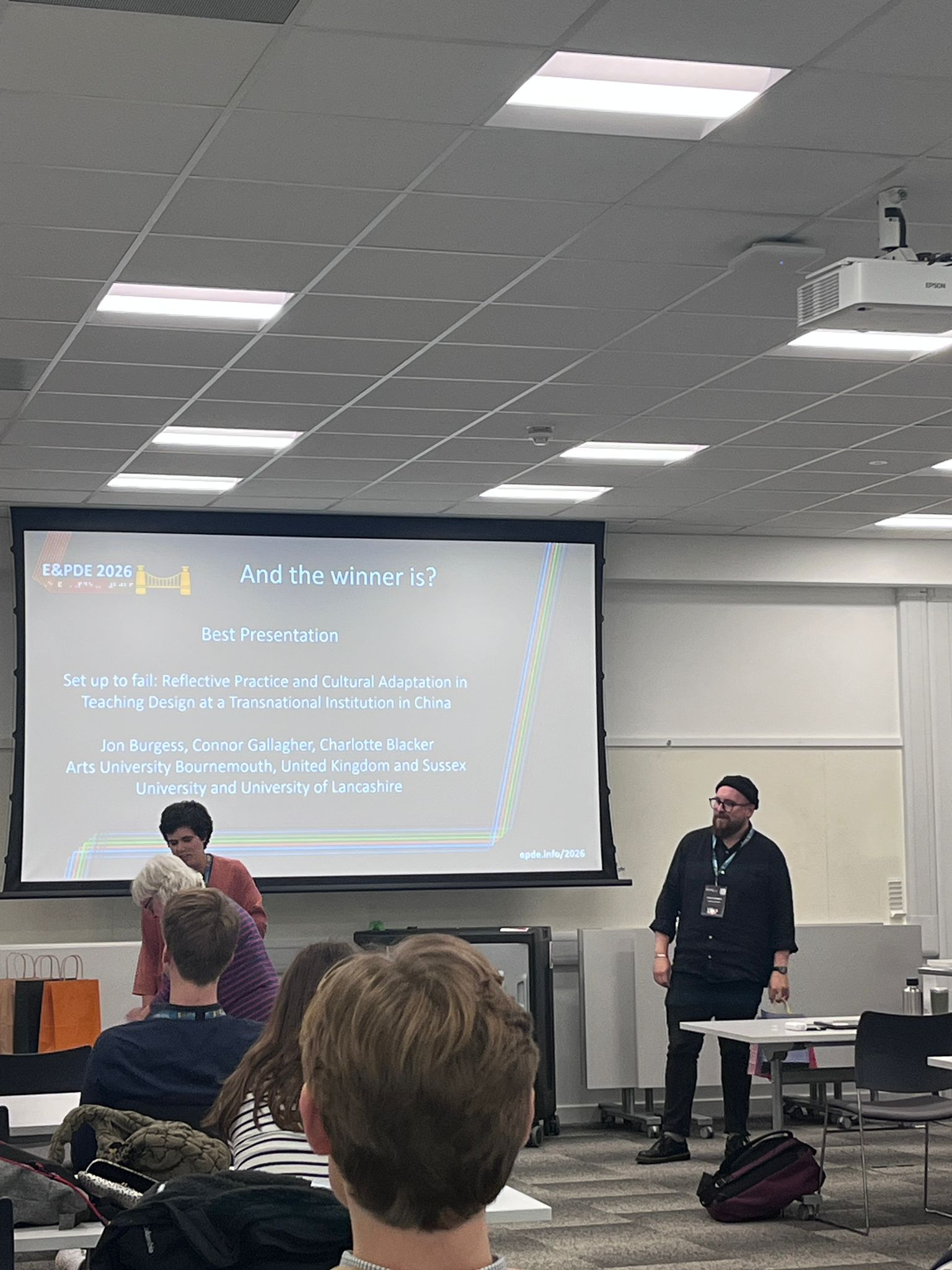
Connor Gallagher, a Postgraduate Researcher (PGR) at AUB, was awarded the accolade at the 28th International Conference on Engineering and Product Design Education (E&PDE 2026), hosted at the University of Bristol's Clifton Campus from 3–4 September.
Selected from over 95 papers and presentations, Connor’s presentation stood out amongst international academics, educators, and practitioners.
The theme for E&PDE 2026, organised in partnership with the Design Society’s Design Education Special Interest Group (DESIG) and the Institution of Engineering Designers (IED), focused on Exploring Diversity in Engineering and Product Design Education.
Connor presented his paper, titled Set up to fail: Reflective Practice and Cultural Adaptation in Teaching Design at a Transnational Institution in China, co-authored with AUB supervisor Dr Jon Burgess and fellow AUB PGR student Charlotte Blacker.
The research developed from Connor’s experience teaching design within a UK–China transnational higher education setting and addresses a fundamental challenge: Western design pedagogy heavily emphasises experimentation, iteration, and learning through failure, whereas students in China may navigate an educational context influenced by Confucian values, filial piety, and the cultural importance of maintaining “face”.
Rather than treating cultural differences as an obstacle, Connor developed an AI-assisted teaching model grounded in Carol Dweck’s Growth Mindset, and David Kolb’s Experiential Learning Cycle.
Under this model, students use AI tools to transform and reinterpret their initial design concepts. When the AI produces unexpected or unsuccessful results, those outputs are used as neutral ground for critique, reflection, and iteration.
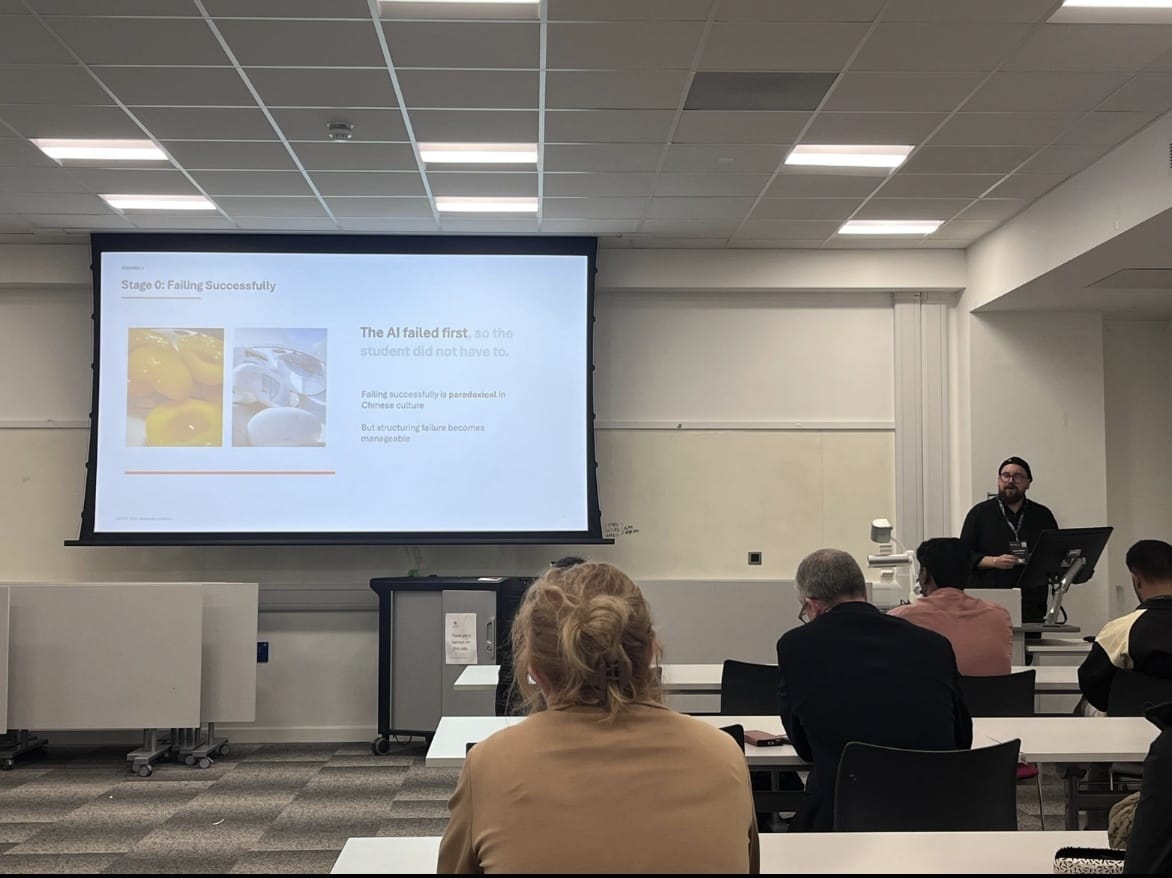
“An important aspect of the approach was that AI created a degree of distance between the student and the perceived ‘failure’,” Connor explains.
“Instead of the student personally being wrong, an AI-generated outcome could be questioned, criticised and even laughed at. This helped create a safer route into discussing failure, experimentation, and iterative design development while remaining sensitive to the cultural context.”
In one practical design session, a student even drew inspiration from her cat to explore materials and pattern development using the AI-supported iterative workflow.
“I was extremely pleased and honoured to receive the Best Presentation award at E&PDE 2026," says Connor. "Presenting this research in Bristol was a brilliant opportunity to share how we can make design education more culturally adaptive.
“As educators working in transnational education or across university settings generally, we need to adapt our pedagogy to the student. If we don't, we risk setting our students up to fail.
"Receiving this recognition from international peers is hugely encouraging as we continue our ongoing work at AUB towards inclusive design and the thoughtful integration of AI systems within the creative design process.”
Valerie Lodge, Research Manager at AUB, adds, “We are absolutely delighted for Connor. To win Best Presentation out of nearly 100 papers at a major international conference like E&PDE is a fantastic achievement, and it highlights the high calibre and global relevance of postgraduate research taking place here at AUB.”