





















































You are using an outdated browser. Most of this website should still work, but after upgrading your browser it will look and perform better.
How your university is funded and invests in you
How your university is funded and invests in you
As a specialist arts university, we’re committed to being transparent about how Arts University Bournemouth is funded and how those resources are used to support your education. Your time here is an investment in your creative practice, your career, your wellbeing, and your future, and we believe it’s important that you understand the financial framework that supports that experience.
This page explains where the University’s income comes from and what sits behind the numbers – how funding is generated, how every pound of tuition fee income is allocated, why these costs exist, and how they directly contribute to teaching, facilities, student support, and long-term investment in AUB.
Our aim is simple: to help you understand how the University operates, what it costs to deliver a high-quality creative education, and how we steward resources responsibly to maximise benefit for students, both now and in the future.
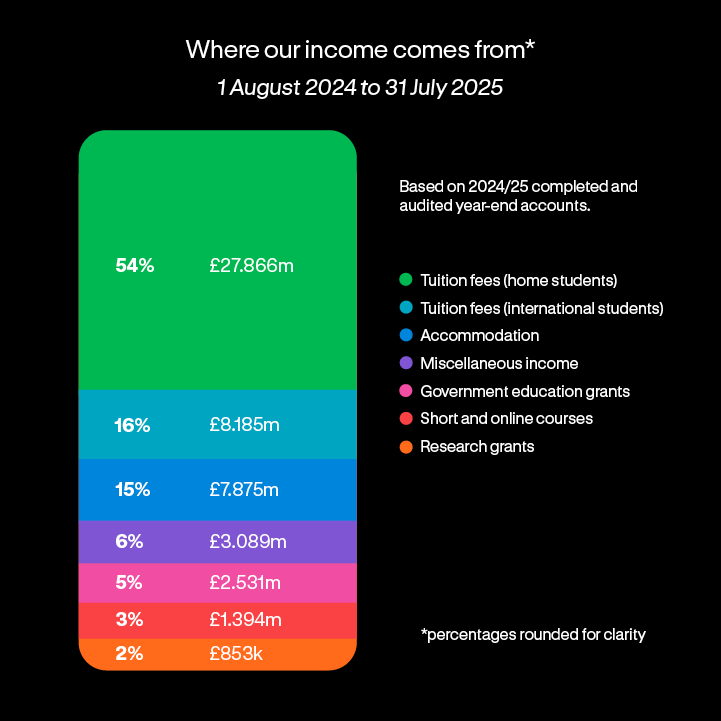
Where the University's income comes from
While tuition fees are an important part of funding higher education, they’re only one component of the University’s overall income. Universities draw funding from several sources, which together support teaching, facilities, student services, and future investment.
Understanding these income streams helps provide context for the spending breakdown shown and illustrates how the University is aiming to maintain a balanced and sustainable financial model.
Home students
This represents the largest share of university income.
What it includes: Undergraduate, Postgraduate and Foundation tuition fees paid by UK students.
International students
Fees from international students provide an important additional source of funding.
What it includes: Tuition fees from students who’ve arrived here from outside the UK.
Accommodation income
Many universities operate student residences, which generate income separate from tuition fees.
What this includes: Rent from university and externally managed student accommodation. This income contributes directly to maintaining residential facilities.
Public funding is provided to support higher education delivery. Funders include the Office for Students and the Department for Education.
What this funding supports:
- High-cost subject delivery
- Access and participation initiatives
- Strategic national priorities
These grants complement tuition income and help maintain quality provision.
Some income supports research, innovation, and collaboration. Funders include Innovate UK, industry partners and external programmes.
Why this matters:
Research activity:
- Enhances teaching quality
- Keeps curriculum industry relevant
- Supports innovation
The University provides flexible and alternative learning pathways to expand learning opportunities to wider range of learners.
This category includes partnership and external activity income.
Examples:
- Validation partnerships
- Collaborative programmes
- Facility use
- External service activity
Why this matters
Diversified income:
- Reduces reliance on a single funding source
- Supports strategic investment
- Increases resilience in a changing sector
Why income diversity matters to AUB
Having multiple income streams allows the University to:
- Maintain stable operations
- Invest in facilities and student experience
- Respond to sector changes
- Continue improving teaching environments
It demonstrates that tuition fees are one part of a broader financial eco-system, rather than the sole source of funding.









Understanding how your tuition fees are spent
The principles behind how we use tuition fees
We follow several core principles when deciding how tuition fee income is allocated:
- Student-centred spending: The majority of our budget directly supports teaching, studios, specialist equipment, workshops, and student-facing services.
- Quality and safety: As a creative university, we maintain specialist environments – workshops, studios, digital suites, theatres, and technical spaces – all of which must meet high professional and safety standards.
- Fair access and wellbeing: We invest in wellbeing, disability support, learning support, and careers services to help all students progress and succeed.
- Long-term investment: A portion of the income is reinvested into future improvements, which includes but isn’t limited to new facilities, updated equipment, and strategic developments.
- Keeping the University running: Behind the scenes, there are essential costs that ensure the University functions, e.g. IT systems, estates, energy, governance, HR, finance, and compliance.
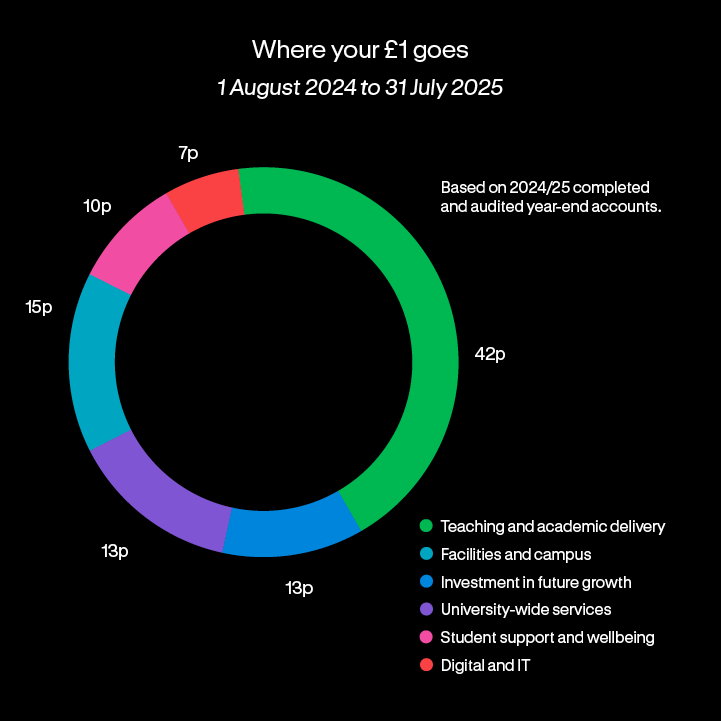
Where your tuition fees go: a breakdown
Every penny of your tuition fees is valuable to us. Discover all the areas where we invest your money to maintain, develop and enhance the University, your courses, facilities and student experience.
This is the largest area of expenditure and represents the cost of delivering high-quality, specialist creative education.
What this covers
- Academic staff salaries (lecturers, course leaders, tutors)
- Visiting professionals and industry speakers
- Technical staff and demonstrators
- Assessment, feedback and academic support
- Course materials and specialist learning resources
Why it matters
Your courses are resource-intensive. Creative studios, technical support, one‑to‑one feedback, and hands-on instruction all contribute to a high-contact, personalised learning experience.
Teaching costs include:
- Academic staffing: Lectures, tutorials, one-to-one feedback, visiting tutors
- Technical staffing: Workshop supervision, equipment support
- Course delivery: Materials, licensing, industry speakers
We want every student to feel supported throughout their journey while also being part of a vibrant creative community. Alongside academic provision, the University invests in services and activities that promote wellbeing, inclusion, professional development, and opportunities to engage creatively beyond the classroom.
What this covers
- Counselling and mental health support
- Disability and inclusive learning support
- Library, archives and study skills services
- Careers and employability services
- Students’ Union funding
- Events, exhibitions and galleries
- Student projects and creative initiatives
- Outreach and widening participation
Why it matters
Demand for wellbeing and support services continues to grow nationally, and universities are investing more each year to meet student needs. At the same time, creative community activities play an essential role in shaping student experience – providing platforms to showcase work, develop networks and build confidence.
Together, these services and initiatives help ensure students are supported academically and personally, while also fostering inclusion, collaboration and creative expression.
Costs include:
- Wellbeing and mental health: Counselling, workshops, crisis support
- Inclusive learning: Dyslexia support, adjustments
- Library and learning: Books, digital resources, study support
- Careers: Placements, portfolio support, industry events
- Students' Union and community: Clubs, societies, representation
- Creative engagement: Exhibitions, events, student projects
- Outreach: Access programmes, widening participation
A creative university campus requires continuous upkeep and investment to stay aligned to higher education and industry standards.
What this covers:
- Maintaining workshops, studios, performance spaces and facilities
- Health and safety compliance
- Energy, heating, lighting and utilities
- Cleaning, security, maintenance staff
- Repairs, renewals and ongoing improvements
Why it matters
Creative spaces degrade faster due to heavy use of equipment and materials. Regular maintenance and investment keep the campus safe, modern and fit for purpose.
Costs include:
- Workshop maintenance: Tools, ventilation, safety equipment
- Buildings: Repairs, accessibility updates
- Energy and utilities: Lighting, heating studios
Digital infrastructure is a major component of modern education.
What this covers
- Learning platforms (VLE, submission portals)
- Software licences (Adobe CC, Wiseflow, Microsoft, Canvas etc.)
- Network infrastructure and Wi-Fi
- Cybersecurity and data protection
Why it matters
Creative programmes rely on high-cost digital tools and industry-standard software to prepare students for employment.
These are essential functions that keep the institution operational and compliant.
What this covers
- Admissions and student records
- HR, finance and payroll
- Governance, risk management, legal and audit
- Marketing and communications
- Executive and leadership functions
Why it matters
Regulation in UK higher education is complex and has increased significantly. These functions ensure compliance, financial stability, student protection and transparent decision-making.
We reinvest in the University every year to improve facilities and expand opportunities.
What this covers
- Major refurbishments and improvements
- New courses and curriculum development
- Digital upgrades
- Equipment renewal cycles
- Strategic projects (e.g. Bournemouth Film School development)
Why it matters
Creative industries evolve quickly. Therefore, we need to invest so students have access to up‑to‑date environments and tools.
Your tuition fees are an important part of how the University is funded, but they sit within a wider mix of income sources that together support the full student experience. These resources sustain a specialist, high-quality creative university – providing the spaces, people, tools, services, and opportunities that enable you to learn, develop, and thrive.
By understanding both where our funding comes from and how it’s used, we hope you feel confident that resources are managed responsibly, invested thoughtfully, and directed toward supporting students and strengthening the University for the future.